
Best Dentist in Indore: How to Find the Right Dentist for Your Dental Needs
Choosing a Dentist Is More Than Choosing a Name
Searching for a dentist in Indore is easy. Choosing the right dentist is much harder. Open Google and you may find dozens of dental clinics, individual dentists, specialists, hospitals, and online directories. You may see:
* Highly rated dentists
* Experienced dentists
* Cosmetic dentists
* Implant specialists
* Orthodontists
* Root canal specialists
* Family dentists
* Multi-speciality dental clinics
And almost everyone promises excellent care.
So how do you decide? Should you choose the dentist with the most reviews? The dentist with the most years of experience? The clinic closest to your home? The one offering the lowest consultation fee? Or the one with the most advanced technology?
The answer is: None of these factors should be considered in isolation. The right dentist depends on your dental problem, your individual needs, the complexity of your case, and the type of care you require. A dentist who is ideal for a routine dental check-up may not necessarily be the right professional for a complex surgical procedure.
Similarly, someone looking for clear aligners may need a different type of clinical expertise than someone suffering from severe tooth pain.
That is why this guide focuses on a more useful question: How do you find the right dentist for your particular dental need?
Quick Answer:
The best dentist for you is not necessarily the dentist with the highest online rating or the lowest treatment cost. Look for a qualified dental professional who:
* Understands your specific dental problem
* Has appropriate experience for the treatment you need
* Performs a careful diagnosis before recommending treatment
* Explains your options clearly
* Uses appropriate diagnostic technology
* Follows proper infection-control practices
* Provides transparent treatment information
* Respects your questions and concerns
* Offers appropriate follow-up care
* Focuses on your long-term oral health
For complex cases, the right dentist may also involve or refer you to a specialist with additional training in that particular area.
Who Is the “Best Dentist” for You?
There is no universal answer. Consider these examples.
If you have a routine dental problem – A general or family dentist may be able to provide examination, preventive care, fillings, cleaning, and many routine treatments.
If you have severely damaged or infected teeth – You may require a dentist experienced in restorative treatment or root canal therapy, depending on the diagnosis.
If you have missing teeth – You may need a comprehensive assessment involving tooth replacement options such as dental implants, bridges, or dentures.
If your teeth are crowded or misaligned – An orthodontic assessment may be appropriate.
If you need complex oral surgery – An oral and maxillofacial surgeon may be involved depending on the condition and complexity.
If your primary concern is your smile – A dentist experienced in cosmetic and restorative treatment can assess your teeth, gums, bite, facial proportions, and overall smile goals before recommending appropriate options.
The important point is simple:
Don’t start by asking, “Who is the best dentist in Indore?” Start by asking, “What kind of dental care do I need?”
That question makes the search much more meaningful.
Why Choosing the Right Dentist Matters
Your dentist may become someone you see repeatedly over many years. They may help you with preventive dental care, tooth decay, gum health, crowns, root canal treatment, cosmetic dentistry, and many more treatments.
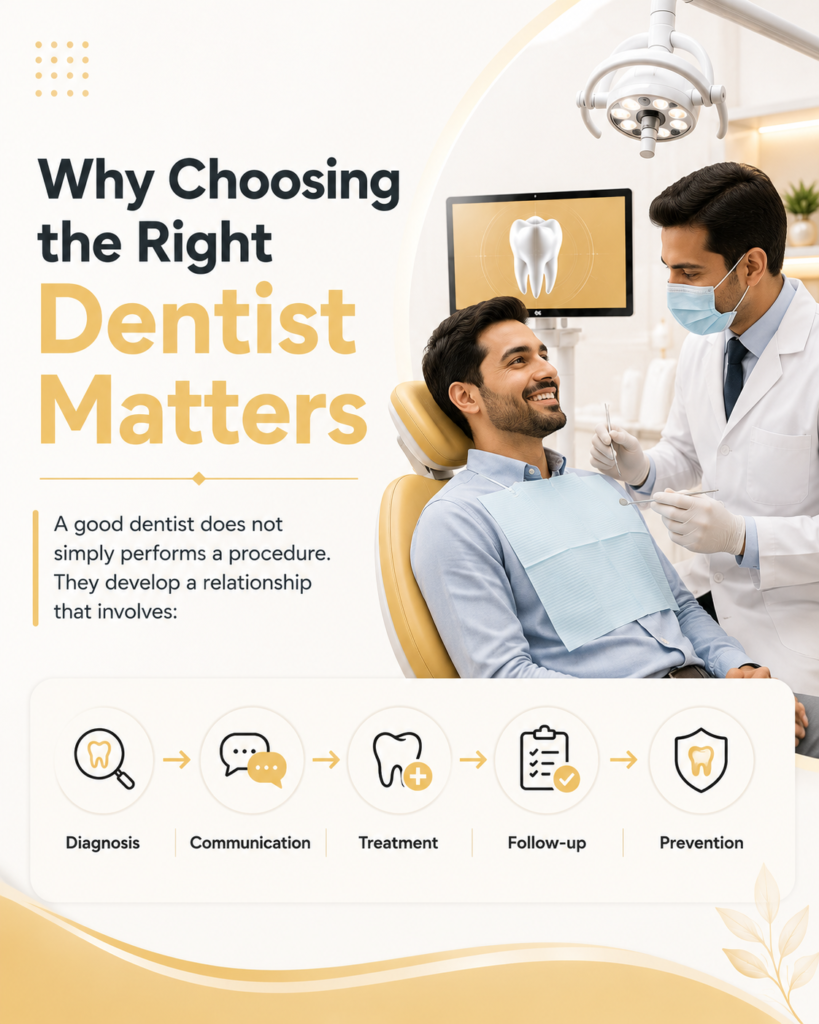
A good dentist therefore isn’t simply someone who can perform a procedure. The relationship should also involve:
Diagnosis → Communication → Treatment → Follow-up → Prevention
This long-term approach can help you make better decisions about your oral health.
The 10 Most Important Things to Look for in a Dentist
Before selecting a dentist, evaluate these ten factors.
- Appropriate Qualifications – Start with the basics. A dentist should have the appropriate professional qualifications and registration required to practise dentistry. For treatments requiring additional expertise, look at whether the clinician has relevant postgraduate training or experience. Don’t hesitate to ask about qualifications. A professional dentist should be comfortable explaining their education and clinical expertise.
- Experience Relevant to Your Problem – Years of experience can be useful, but relevant experience matters too. For example, suppose two dentists have both been practising for many years. One primarily focuses on routine general dentistry and the other has extensive experience in the specific type of treatment you require. For that particular problem, the second dentist may be more relevant to your needs.
This is why you should ask: “How often do you treat cases like mine?”
rather than simply: “How many years have you been practising?”
- Quality of Diagnosis – A treatment plan is only as good as the diagnosis behind it. A thorough dental assessment may involve:
* Clinical examination
* Medical and dental history
* Dental photographs
* Digital X-rays when indicated
* 3D imaging when clinically appropriate
* Assessment of teeth and gums
* Bite evaluation
* Discussion of symptoms and concerns
Not every patient requires every diagnostic test. The important factor is whether the dentist chooses diagnostic tools appropriately for the individual case.
- Ability to Explain the Problem Clearly – You shouldn’t need a dental degree to understand your own diagnosis. A good dentist should be able to explain your condition in language you can understand. For example, after a consultation, you should ideally know: What is wrong? Why did it happen? How serious is it? What are my treatment options? What happens if I don’t treat it? What should I do next? If you leave the clinic more confused than when you entered, it may be worth asking for further clarification before proceeding.
- A Patient-Centred Treatment Approach – Understanding the patient is the basis of any dentistry, or any medical treatment, for that matter. A dentist should know your concerns, expectations, oral health and medical history, lifestyle and priorities because good dentistry is not simply about performing procedures. You should feel comfortable asking questions. You should also feel that your concerns are being heard rather than dismissed.
- Appropriate Use of Technology – Modern dentistry offers many useful technologies. Depending on the treatment, these may include:
* Digital radiography
* Intraoral scanning
* CBCT imaging
* Digital treatment planning
* CAD/CAM workflows
* Digital smile planning
* Modern endodontic systems
But remember, more technology does not automatically mean better dentistry. The technology should have a purpose. A good clinic uses technology when it can improve diagnosis, planning, communication, precision, documentation, or patient experience.
- Strong Infection-Control Practices – Dental treatment involves close contact with the mouth and requires careful attention to infection prevention. Patients should expect a clean, organized clinical environment and appropriate sterilization and infection-control practices. You can ask:
* How are instruments sterilized?
* How are treatment rooms prepared between patients?
* What infection-control procedures are followed?
A trustworthy dental practice should not make you feel uncomfortable for asking these questions.
- Transparent Treatment Planning – Before starting significant treatment, you should understand what is being recommended and why. Ask about the diagnosis, treatment options, how many times you might have to visit, estimated cost, and approx recovery time. You don’t necessarily need every detail on your first visit. But you should have enough information to make an informed decision.
- Reviews That Tell a Story – Online reviews can be useful—but don’t look only at the star rating. Instead, read what patients actually say. Look for recurring themes that involve communication, professionalism, comfort, staff behaviour, and overall experience. One extremely positive or negative review may not tell you much. And remember: Online reviews are one input—not a substitute for your own clinical consultation.
- Long-Term Follow-Up – Dental treatment doesn’t always end when the procedure is completed. It continues with the follow-ups. A dentist who actually cares for your long-term oral health will monitor healing, check restorations, help maintain implants, manage gum health, and address any further concerns.
Best Dentist in Indore: Don’t Choose by Price Alone
One of the most common mistakes patients make is comparing dentists only by consultation fee or treatment cost. Suppose one clinic quotes ₹X and another quotes ₹Y. That doesn’t automatically tell you which one provides better care. The difference lies in the laboratory work, number of appointments scheduled, treatment planning, and technology and materials involved. So, instead of asking: “Why is your treatment more expensive?”
consider asking: “What is included in this treatment plan, and why is this option appropriate for my case?”
That question leads to a much more meaningful discussion.
The Dentist Selection Formula
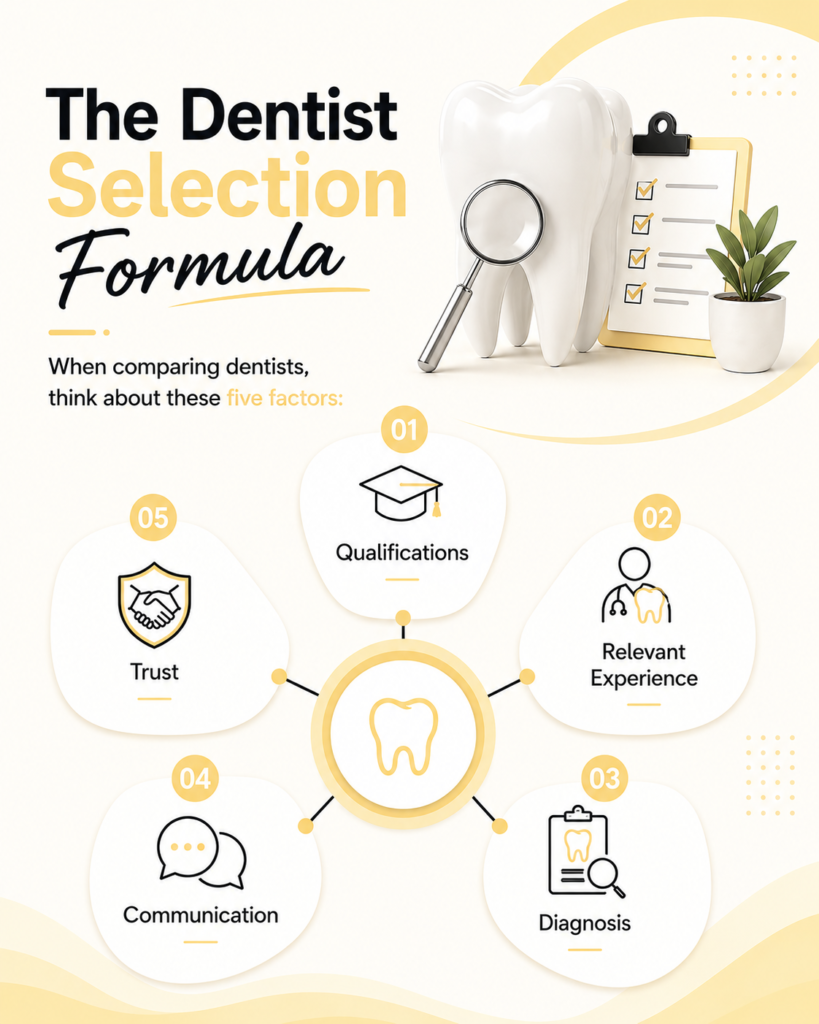
When comparing dentists, think about these five factors:
Qualifications – Does the dentist have the appropriate professional training?
Relevant Experience – Do they regularly manage the type of problem you have?
Diagnosis – Do they take enough time to understand your condition?
Communication – Can they explain your options clearly?
Trust – Do you feel comfortable making a healthcare decision with them?
If all five are strong, you’ve probably found a promising candidate.
A Simple 5-Minute Dentist Evaluation
Before booking treatment, ask yourself:
Question 1 – Did the dentist listen to me?
Question 2 – Do I understand my diagnosis?
Question 3 – Were my treatment options explained?
Question 4 – Do I understand why the recommended treatment is appropriate?
Question 5 – Do I feel comfortable asking questions?
If the answer to all five is yes, that’s a good starting point.
If several answers are no, don’t be afraid to seek clarification or another professional opinion when appropriate.
When Should You Consider a Second Opinion?
A second opinion can be useful when:
* You have been advised to undergo extensive treatment
* Several treatment options are available
* You are unsure about the diagnosis
* You are considering major restorative work
* You are uncomfortable with the proposed treatment
* You simply want greater confidence before making a significant decision
Getting another professional perspective does not mean you don’t trust your dentist. It can simply help you understand your options better.
Expert Tip
Don’t choose a dentist because they promise the most impressive result. Choose a dentist who can clearly explain the diagnosis, the realistic options, the limitations, and the long-term maintenance involved.
That is a much stronger foundation for making a healthcare decision.
One Important Difference: Dentist vs Dental Clinic
Patients often use these terms interchangeably, but there is a practical difference. A dentist is the individual clinician providing dental care. A dental clinic is the practice environment where one or more dental professionals may provide different types of care. For a straightforward problem, choosing an individual dentist may be sufficient. For a family or complex case, a comprehensive clinic may offer an advantage because different areas of dentistry can potentially be coordinated through one practice. The right choice depends on your needs.
What Should You Do Before Your First Dental Appointment?
A little preparation can make your consultation much more useful. Bring or note:
* Previous dental records, if available
* Current medications
* Relevant medical history
* Previous X-rays, if available
* Your main dental concerns
* How long you’ve had symptoms
* Any previous dental treatments
* Questions you want to ask
Also tell your dentist if you have experienced any tooth sensitivity, swelling, jaw pain, bleeding gums, tooth mobility, or any other oral problems. Don’t assume a symptom is too small to mention. Sometimes seemingly minor details help your dentist understand the bigger picture.
Your Goal Should Not Be to Find a “Famous” Dentist
A famous dentist is not necessarily the right dentist for every patient. Likewise, a dentist with a smaller online presence may provide excellent clinical care. The better question is: Is this dentist qualified, experienced for my needs, careful in diagnosis, transparent in communication, and committed to my long-term oral health?
That’s the standard that matters.
Key Takeaway
If you remember only one thing from this article, remember this: The best dentist for you is the one who is best suited to your specific dental needs—not simply the dentist with the highest rating, the lowest price, or the biggest online presence.
Take time to understand your condition.
Ask questions.
Compare appropriately.
And choose a dental professional you can trust for the long term.
